

On Swedish legalities: all things residence permit, personnummer, Swedish ID, and the bank account
Alright, folks, it’s that time of the year. Unfortunately for me, I can’t just talk about all the great things Stockholm has to offer, how nice KI Housing is (did you apply yet, my fellow non-EU student?), and the growing vibrant life of the rapidly coming summer. Fortunately for you, this means I have now decided to dedicate this blog to something that caused me numerous headaches: navigating Swedish bureaucracy.
So, in the spirit of this, let us demystify what these processes are, why they matter, and how to go about them without needing to live with a constant migraine as soon as you arrive. Please bear with me; this will be a long and hefty post—with very little of the lovely imagery I normally like to include—but I promise it’ll be worth it.
The Swedish residence permit
Before you can begin your Swedish adventure of becoming addicted to cardamom buns and pretending you understand how to pronounce “sjuksköterska,” there is the quite obvious detail of obtaining the residence permit. For most non-EU students, this is the golden ticket that allows you to actually come to Sweden.
As a Mexican national, the process was thankfully a bit simpler because Mexico is a visa-free country for Sweden (so keep in mind that what I’ll describe for the residence permit is essentially specific to visa-exempt non-EU countries). Due to this, I did not need to wait for my residence permit card before travelling to Sweden. Instead, I was able to enter the country first and complete the biometrics process once in Stockholm.
The application itself was entirely electronic through the Swedish Migration Agency (Migrationsverket) website. I uploaded my passport, proof of admission from KI, financial documents, and health insurance information if applicable (KI will tell you what to put here depending on your situation), and then the waiting game begins. Make sure to always check the actual requirements as they may change from time to time!
Because I did not need an entry visa, I had to book an appointment at one of the local offices. The Stockholm ones are usually quite busy, but fret not as there are multiple surrounding towns that offer the same service. For me, I ended up going to Västerås to have my biometrics taken, which became a cute roadtrip with my parents. This card then gets mailed to your Swedish address and officially becomes your proof of legal residence here, and it took about a week and a half to reach me.

The Swedish “personnummer”
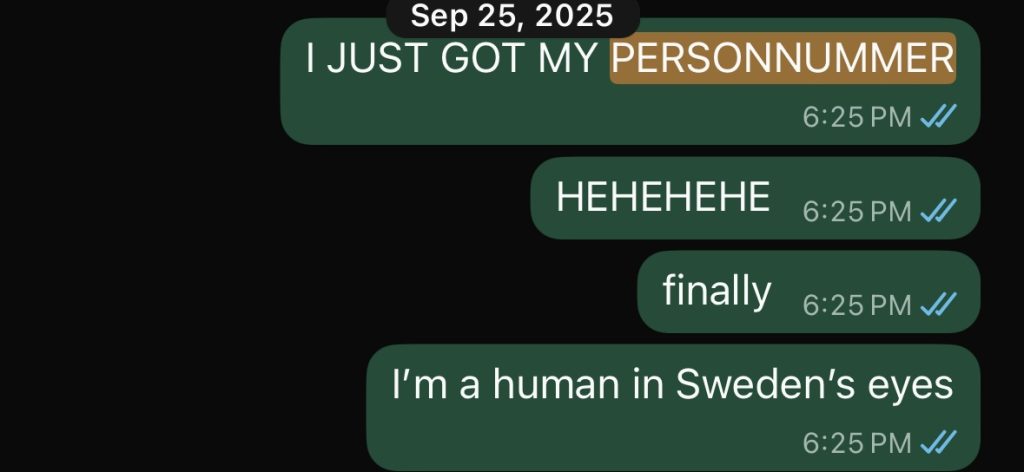
Next up, we have the good old personal number AKA “personnummer”, without which you are not considered human by the Swedish government. Okay, a bit of an exaggeration there, but you’ll get the joke.
Once you have your residence permit and have officially arrived in Sweden, the next major step is registering with the Swedish Tax Agency (Skatteverket) in order to obtain your personal identity number. Generally speaking, if your residence permit is valid for more than one year, you are eligible to receive one and, trust me, you’ll want to start this process ASAP. Using their e-service, start by notifying them of your move to Sweden and booking an in-person appointment (check the website above).
During the appointment, bring important documents such as your passport, residence permit card, admission documents, and proof that you are studying in Sweden (make sure to double check requirements on their website directly, and that you don’t forget them on the day of!). Once registered in the Swedish Population Register, you are assigned your personnummer and formally become a human being in the eyes of Swedish authorities. You did it!
The waiting time varies greatly; some people receive it within a couple of weeks, others wait significantly longer. In my case, it took about two weeks so I guess I still had some good karma on my side.
Once you finally receive what feels like a magical number that gives you human rights, life becomes noticeably easier. Healthcare, banking, identification systems, memberships, digital services, you name it.
The Swedish ID
Remember when I said that getting your personnummer means becoming a human being in Sweden’s eyes? I lied! I know, I’m sorry. But for us non-EU students, procuring the Swedish ID card is a must.
Mundane activities from picking up packages to entering pubs become significantly harder since Swedes are super strict when it comes to having an official ID document which, in Sweden, is either a local ID card or your passport. Mind you, I did not feel like taking my passport on strolls around the city, much less on boozy nights out, so I made sure to get this as fast as possible.
Once you have received your personnummer, you can apply for the ID card through Skatteverket, specifically this website. The process is relatively straightforward: pay the application fee in advance and bring the receipt, book an appointment (make sure to check which locations offer the right service), bring valid identification documents and your residence permit card, and have your photo taken there. A few weeks later, your ID card will be ready for pickup.
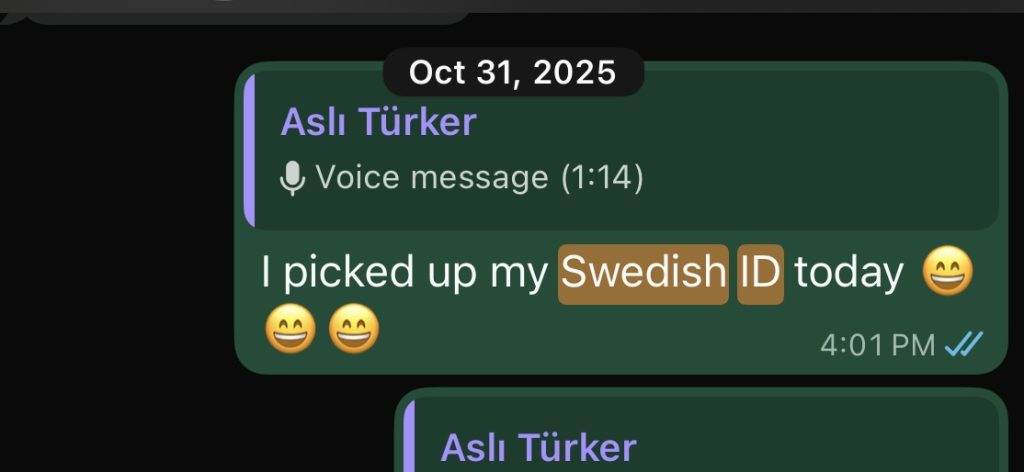
And let me be fully frank with you, finally getting the Swedish ID card feels quite emotional. After two months of paperwork and appointments, holding that little card suddenly made everything feel real, even myself—honestly, at that point I was doubting whether I actually existed. So after this step, congratulations, you are now bureaucratically Swedish!
The bank account
If you thought it was over, well, think again, because the bank account is another beast entirely. I know, I cried literal tears of frustration over this bad boy. But hey, maybe I went through that so you won’t have to, so on with it.
Having a Swedish bank account is extremely useful because Sweden is, quite frankly, lethally allergic to cash. I haven’t come across a single place that accepts it, and digital payment systems like Swish are the cool kids of Swedish economy. Without a Swedish bank account, certain things become unnecessarily complicated very quickly, and you will need one if you are planning to get a job while you study so you can get paid.
However—and this is the core of it all—opening a bank account as a newly arrived international student is quite literally like trying to enter the most exclusive secret society on Earth. Banks often request your personnummer, Swedish ID, proof of studies, proof of address, and basically your whole life story. And guess what? Even if you meet all the criteria, they can still refuse you (it’s a huge hit and miss with these guys).
I tried opening a bank account with SEB (one of the big Swedish banks) as they market themselves as being friendly towards international students. How very lovely it was to get rejected by them not once, not twice, but thrice, at which point I decided to stop getting bread-crumbed and I moved on to the next alternative recommended by a fellow Digital Ambassador (forever in debt with you, Riti), which worked on my first try: Swedbank. I simply showed up in person, took a turn, and waited for some time before the agent decided to change my life by agreeing to set my bank account up (shout-out to him).
However, I have heard all kinds of stories from all kinds of students: some found SEB to be amazing, others Swedbank to be inaccessible, and the same story goes for all other banks. Like I said, it feels like being part of the Mean Girls movie and desperately wanting the cool group’s approval, so just be persistent and don’t panic if one option does not work. So, try whatever avenue you can and, most importantly, be patient.
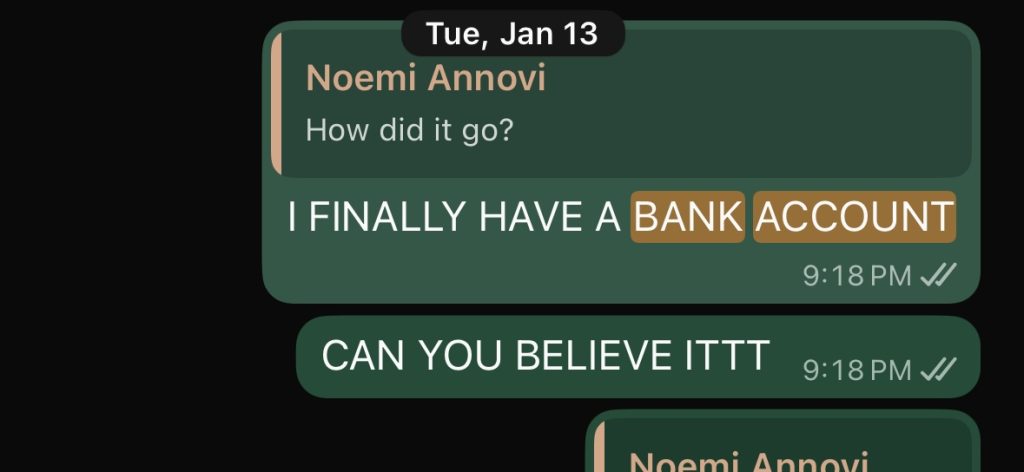
It took me months to finally open a bank account, and honestly once I had both my personnummer and Swedish ID card, the process became much more straightforward, so I would prioritise these two before moving on to this one.
In short
If you’ve made it this far, thank you for bearing with me. I know this can be quite overwhelming, and there will absolutely be moments where you stare at government websites wondering if they are purposefully designed to test your self-control. But eventually, as long as you do your part, everything will fall into place. Just start early, stay organised, and ask others for help. One day, you too will suddenly catch yourself explaining how to get a Swedish ID to another confused international student, and the cycle will continue for generations to come. Stay tuned for my last blog of the semester, and see you soon!

Luis - Global Health
Hey! I’m Luis, and I'm currently studying the Master’s in Global Health. I’m from San Luis Potosí, Mexico (no, the city wasn’t named after me) but also grew up in Belgium and Colombia, which sparked my love for international living. After completing my Bachelor’s in Montreal, I felt ready for a new adventure, this time in Sweden! Experiencing diverse healthcare systems inspired my passion for global health, which led me straight to KI. In my free time, I enjoy city strolls and fika—though I only drink milk, not coffee!
0 comments